


Choosing between a burst fade vs drop fade comes down to one question: where does the fade go after it reaches your ear? A burst fade curves in a half circle around the ear and usually leaves length at the nape.
A drop fade keeps going around the head and dips lower behind the ear, so the sides and back look connected. People search this topic to settle a barber decision, match a photo to the right name, and avoid a cut that grows out badly.
Below you will find clear placement references, a side by side comparison, a simple ear and nape test, barber scripts, upkeep timelines, and quick answers to common questions.
Burst Fade vs Drop Fade: Three Placement References
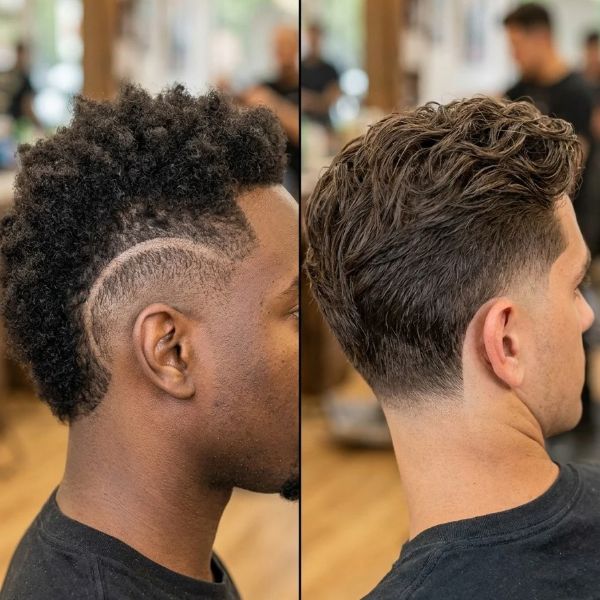
Photos are the fastest way to learn the difference, but only if you know where to look. Use these three reference angles when you compare any picture, whether it is saved on your phone or pinned to a style board.
- Side profile reference. Look at the area directly around the ear. In a burst fade, the shortest hair forms a rounded arc that wraps the ear like a sunburst. In a drop fade, the guideline (the line where the shortest section ends) travels past the ear and slopes downward.
- Back view reference. This is the most useful angle. If the hair at the nape stays long, the cut is a burst fade. If the fade continues across the back of the head and tapers the neckline, the cut is a drop fade.
- Three quarter reference. Stand slightly turned from the camera. A burst fade shows a clear contrast zone around the ear with a longer back behind it. A drop fade shows one smooth curve that sweeps from the temple, behind the ear, and toward the nape.
A quick memory trick: burst is about the ear, drop is about the whole back of the head.
Burst Fade vs Drop Fade at a Glance
| Feature | Burst fade | Drop fade |
| Shape | Half circle around the ear | Continuous curve that dips behind the ear |
| Back and nape | Often left longer | Faded and tapered |
| Visual focus | The ear and temple area | The full side and back outline |
| Pairs well with | Mullet, mohawk, faux hawk, curls | Crew cut, side part, textured top, waves |
| Office friendliness | Good when kept low | Excellent in most dress codes |
| Typical touch up | About every 2 to 3 weeks | About every 3 to 4 weeks |
Compare your preferences first
Before you pick a side, answer these quick questions. Your answers usually point to the right cut.
- Do you want to keep or grow length at the back, such as a mullet or curly nape?
- Do you want the ear area to be the feature, or do you want a quiet, even outline?
- Do you work or study somewhere with a strict grooming standard?
- How often are you willing to visit a barber?
- Is your hair fine, straight, curly, or coily?
If you said yes to length at the back and a bold look, lean burst. If you want a tidy, low drama finish that holds up between visits, lean drop.
What a Burst Fade Actually Does
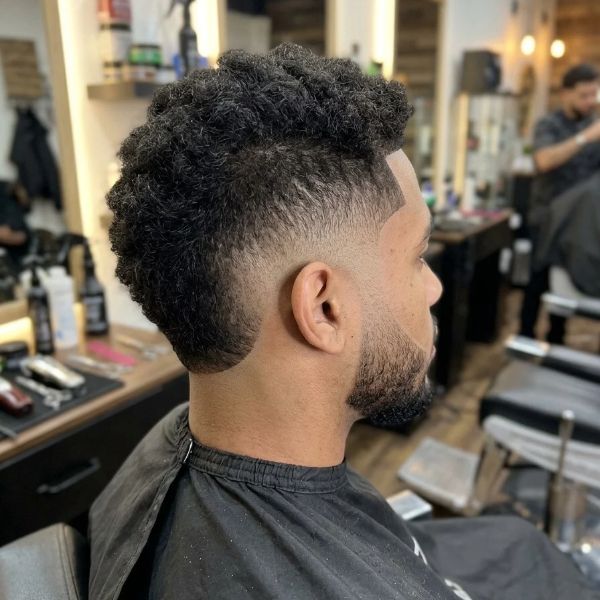
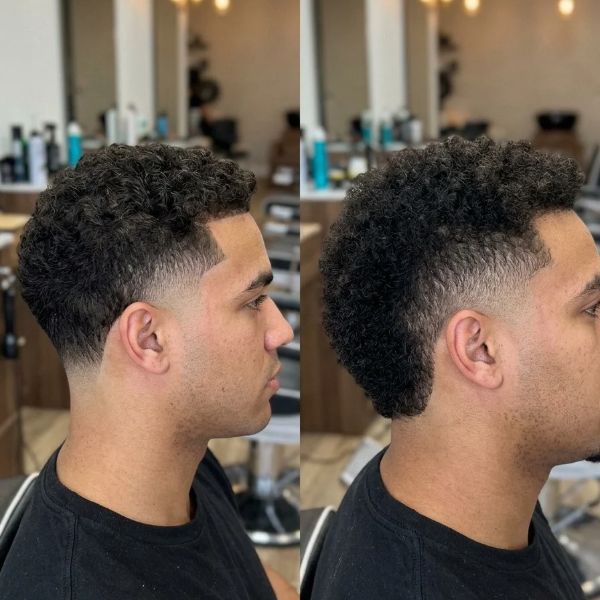
A burst fade is defined by its curve. The barber blends the hair in a semicircle around the ear, then stops the fade instead of carrying it through the back. The result looks like the hair is radiating outward from the ear, which is why the style is called a burst.
Here is what that means in real life:
- It creates contrast. The skin or very short hair near the ear stands out against the longer hair behind and above it.
- It protects back length. Because the fade does not wrap the nape, you can keep a mullet, a ponytail section, or natural curls in the back.
- It works at different heights. A low burst sits close to the ear. A mid or high burst climbs higher on the side and looks bolder.
A mullet is a haircut with short sides and a longer back. A mohawk keeps a strip of longer hair down the center with shaved sides.
A faux hawk is a softer version where the center strip is styled upward without fully shaving the sides. All three are popular partners for a burst fade because the fade frames the ear while the length stays intact.
The tradeoff is that the shape depends on a clean arc sitting against longer hair. Once the arc blurs, it loses its sharpness faster than a continuous fade does. That is why burst fades often need a refresh a little sooner.
What a Drop Fade Actually Does
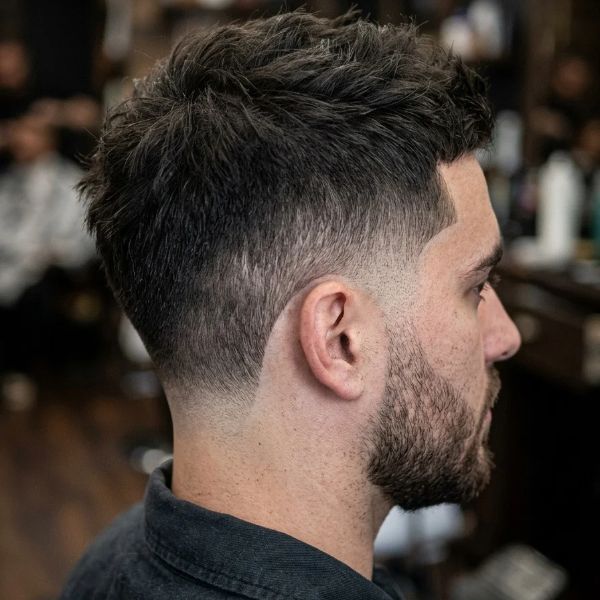
A drop fade is still a continuous fade around the head. The difference is that its guideline drops lower behind the ear instead of staying level. This follows the natural curve of the skull, so the cut feels smooth and connected from front to back.
Key traits of a drop fade:
- It tidies the whole back. The nape and neckline are included in the fade, so the entire lower head looks cleaner.
- It reads as subtle. Compared with a burst, the drop is quieter and easier to wear with classic styles.
- It grows out evenly. Since there is no hard semicircle to lose, the fade softens across the back instead of breaking in one spot.
Classic tops such as a crew cut (short hair on top, tapered sides) or a side part (hair combed to one side with a defined parting line) show off a drop fade well.
Many men also choose it with waves or a textured crop because the clean outline lets the top do the talking.
There is also a hybrid called a drop burst fade. It keeps the rounded ear shape of a burst but lets the fade drop low behind the ear. If you like both looks, this is a useful middle path to show your barber.
The Ear and Nape Test
If you ever feel unsure about a photo or a barber’s result, run this simple two step test. It takes about ten seconds.
- Check the ear. Is there a tight, rounded arc of short hair around it? If yes, the cut has burst features.
- Check the nape. Look at the back of the head, just above the neck.
- Long hair at the nape means a burst fade.
- Faded hair that continues across the back and tapers the neckline means a drop fade.
- Rounded ear shape plus a low, faded back means a drop burst hybrid.
This test is also handy for search results. Many images online are labeled loosely, so checking the back view helps you avoid asking for the wrong cut.
If you cannot see the back in a photo, ask your barber to review a second angle with you.
Choose the Finish Separately
Many people mix up the style (burst or drop) with the finish (how short the shortest part goes). These are two different decisions, and treating them separately saves you from surprises.
Finish options include:
- Skin fade (bald fade). The hair blends down to bare skin. It is sharp and high contrast.
- Shadow fade. The hair blends down to a very short stubble, which looks softer than skin.
- Guard fade. The barber ends at a specific clipper guard length, such as a number 1 or 2. Guards are plastic attachments that set how much hair the clippers leave behind.
- Height. Low, mid, or high describes where the fade begins on the side of the head.
A few practical pairings:
- A low skin burst gives a clean ear focus without looking extreme.
- A mid shadow drop gives a soft, professional finish that grows out gently.
- A high skin burst is the boldest combination and needs the most upkeep.
If your workplace is conservative, start with a shadow or low guard finish. You can always go shorter next time, but you cannot add hair back.
Which One Should You Choose?
There is no universal winner. The better pick depends on the rest of your haircut and your daily routine. Use the lists below as a decision shortcut.
Choose a burst fade if…
- You want to keep or grow length at the nape, such as with a mullet.
- You wear a mohawk, faux hawk, or curly top and want the fade to be a feature.
- You like a bold, modern look and do not mind frequent touch ups.
- You have natural texture or curl that looks great against sharp sides.
- You want the ear area to be the visual center of the cut.
Choose a drop fade if…
- You want one continuous fade that tidies the entire back of your head.
- You need a cut that passes a strict dress code with ease.
- You prefer a look that stays sharp for three weeks or longer.
- Your hair is fine or thinning and you want less contrast on the sides.
- You wear classic styles like a side part, crew cut, or textured crop.
If you are still undecided, a safe plan is to start with a drop fade and try a burst on your next visit. That way you learn how your hair and face respond before you commit to a bolder shape.
How to Ask Your Barber
Clear words prevent most haircut mistakes. Barbers use slightly different names for the same cuts, so mix a short script with a photo and a back view.
Try these scripts:
- For a burst fade: “Keep the fade rounded around the ear and leave the back length intact.”
- For a drop fade: “Carry the fade around the head, but let it drop lower behind the ear instead of keeping the guideline level.”
- For a hybrid: “I want a rounded ear shape, but let the fade drop low behind the ear.”
Then add these details:
- Height: low, mid, or high.
- Finish: skin, shadow, or a specific guard number.
- Top length: how much you want left on top and how you style it.
- Neckline: a natural taper, a rounded edge, or a squared line.
- Photos: bring a side view and a back view of the cut you want.
Ask the barber to confirm the plan out loud before they start. A thirty second check is much easier than fixing a cut that went the wrong way.
Maintenance and Grow-Out
Upkeep is where these two cuts feel most different. A drop fade usually holds its look for about three to four weeks, and longer if you chose a guard instead of skin. A burst fade tends to blur sooner, often around the two to three week mark, because its shape depends on a clean arc.
To keep either cut fresh:
- Book ahead. Schedule your next appointment before you leave the chair.
- Edge the lines. A quick cleanup of the neckline and temples extends the life of a fade.
- Moisturize your scalp. Dry skin shows more clearly on a skin fade.
- Use the right product. Light clay or paste for texture, cream for curls, and pomade for sleek styles.
- Protect your skin. Newly exposed skin around the ear can burn in strong sun, so use sunscreen.
Grow-out also differs:
- Drop fade: softens gradually across the back and stays tidy for longer.
- Burst fade: loses the sharp semicircle first, but the longer back hides much of the blur if you are growing a mullet.
If you plan to grow your hair out, a low burst is a friendly transition cut. The sides can fill in slowly while the back length keeps building.
Reference for Fade Technique
Knowing a little about how barbers build a fade helps you describe what you want. A fade is made by moving clippers through different guard lengths, then blending the lines with a lever or a clipper over comb technique.
For skin finishes, a foil shaver (a small electric razor with a thin metal cover) often adds the final smooth edge. The burst arc is shaped by hand around the ear, while a drop fade follows a lower guideline the barber sets behind it.
What is the main difference between a burst fade and a drop fade?
A burst fade curves in a half circle around the ear and often leaves the back long. A drop fade continues around the head and dips lower behind the ear.
Which fade lasts longer between cuts?
A drop fade usually lasts longer, about three to four weeks. A burst fade often needs a refresh around two to three weeks.
Which is better for a mullet?
A burst fade is usually the better partner because it keeps the nape length intact. The fade frames the ear while the back stays long.
Is a drop fade better for work or school?
Yes, in most cases. Its smooth, connected shape looks neat and fits strict grooming standards easily.
Can you combine a burst fade and a drop fade?
Yes. A drop burst fade keeps a rounded ear shape while letting the fade drop low behind the ear.
Which fade works best for curly hair?
A burst fade highlights curls on top and keeps back length if you want it. A drop fade also works well when you prefer a cleaner neckline.
Is a burst fade the same as a taper?
No. A taper is a gradual shortening of the hair, while a burst is a specific curved shape around the ear.
Related visual guides
If you want more reference points before your next appointment, these topics pair well with this comparison:
- Low, mid, and high fade photo guides to compare fade height
- Mullet and mohawk burst fade ideas for longer back styles
- Taper fade versus skin fade comparisons for finish choices
- Curly hair fade styling and product tips
- Beard blend and line up guides to match your fade
Use them as a checklist when you build your own reference board. Collect one side view, one back view, and one three quarter view of the cut you like, and your barber will understand your request in seconds.

Reyansh is an experienced fashion writer with 6+ years of writing experience, passionate about fashion trends, styling ideas, and modern looks. He creates simple, engaging content that helps readers discover their personal style with confidence.